
Press Release
National Policy Roundtable Highlights Critical Role of States in India-EU FTA Readiness and Effective Market Access
The Roundtable underscored that while trade agreements are negotiated at the national level, their economic impact is ultimately realised across states, businesses and communities. Participants highlighted the need to move beyond tariff-based market access towards strengthening the regulatory, fiscal, infrastructural and institutional capacities required to convert the opportunities presented by the India-EU FTA into investment, production, exports and jobs.
The programme was convened with a focus on fiscal federalism, state-level institutional readiness, non-tariff measures, sustainability, supply-chain resilience and business requirements, with particular attention to strengthening Centre-State coordination.
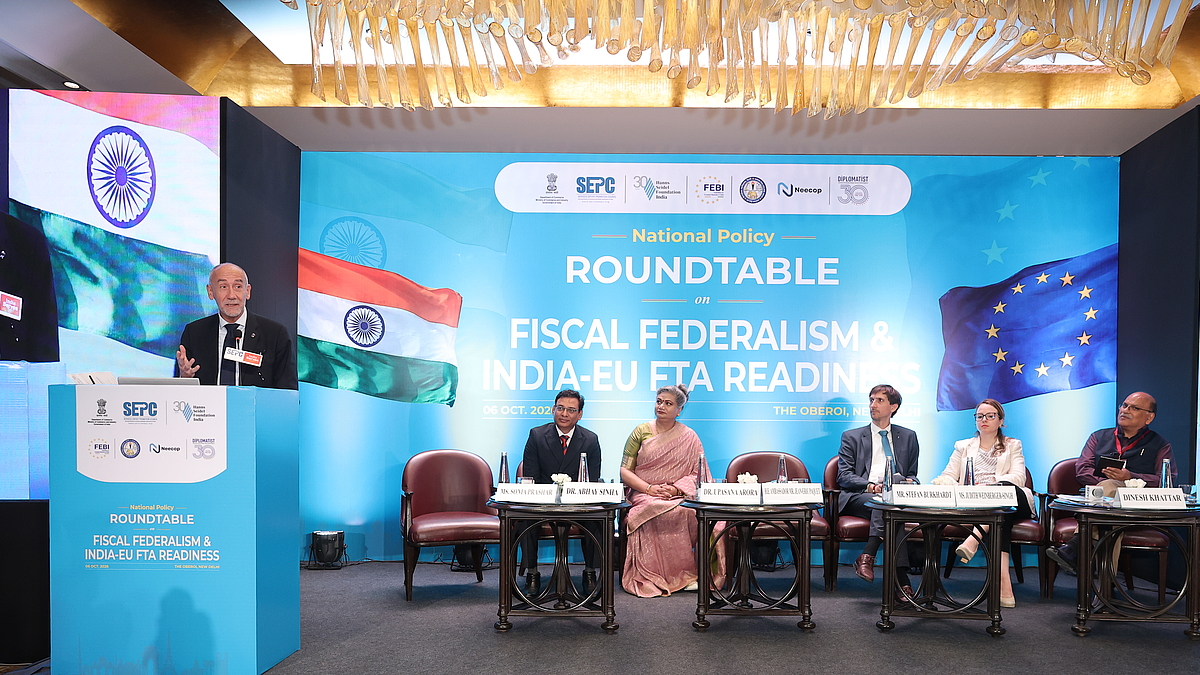
Keynote Address by H.E. Ambassador Mr. Jean-Eric Paquet, Delegation of the European Union to India and Bhutan
European and Indian perspectives set the context
Welcoming participants, Dr. Upasana Arora, Chairperson, Services Export Promotion Council (SEPC) India, emphasised the importance of stronger institutional capacity, coordinated policy action and greater state-level readiness in enabling India to benefit from deeper integration with global markets.
Prof. Dinesh Khattar, Principal, Kirori Mal College, University of Delhi, provided the introductory remarks, highlighting the broader institutional and policy dimensions of India’s preparedness for deeper economic engagement with the European Union.
The Roundtable featured a keynote address by H.E. Ambassador Jean-Eric Paquet, Ambassador of the Delegation of the European Union to India and Bhutan, who highlighted the significance of strengthening India-EU economic relations and translating the FTA’s opportunities into tangible outcomes for businesses, states and communities.
Dr. Abhay Sinha, Director General, Services Export Promotion Council (SEPC), provided the context-setting remarks, drawing attention to the importance of institutional preparedness, coordinated policy action and stronger state-level capabilities.
The opening session also featured remarks by Ms. Judith Weinberger-Singh, Resident Representative, Hanns Seidel Foundation (HSS) India, who stressed the importance of institutional capacity, policy coordination and cooperation in harnessing closer India-EU economic engagement. Mr. Stefan Burkhardt, Head of Division, South and Southeast Asia, Hanns Seidel Foundation, Germany, added a European perspective to the discussion on trade, institutional preparedness and Centre-State coordination.
From national trade policy to state-level implementation
Session I, “Assessing India’s Institutional and Fiscal Readiness for the India-EU FTA,” examined the domestic institutional architecture required to translate bilateral trade commitments into broad-based regional economic growth.
The session brought together Prof. Rekha Saxena, Head of Department & Senior Professor, Department of Political Science, University of Delhi; Prof. Chanchal Kumar Sharma, Dean, School of Election Management, IIIDEM, Election Commission of India; and Prof. V.N. Alok, Professor, Indian Institute of Public Administration (IIPA). The discussion was moderated by Mr. Sujit S. Nair, Chairman, Europe India Centre for Business & Industry (EICBI).
The session highlighted that the effectiveness of tariff concessions will depend substantially on sub-national capabilities, including regulatory coordination, export infrastructure and the fiscal capacity of states to support internationally competitive economic ecosystems.
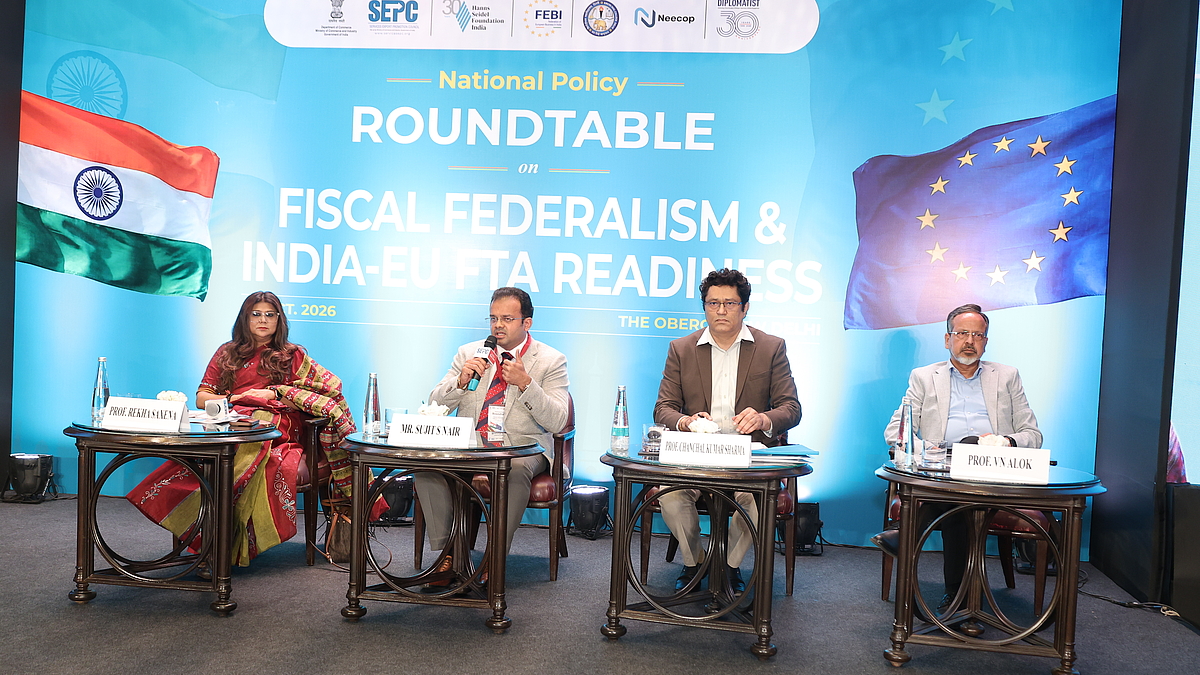
Session I: Assessing India's Institutional and Fiscal Readiness for the India-EU FTA
State capabilities key to addressing modern trade requirements
Session II, “Building State Capabilities for India-EU FTA Implementation: Non-Tariff Barriers, Sustainability and Resilience,” focused on the changing nature of international trade, where non-tariff measures, ESG and sustainability requirements, standards, supply-chain transparency and resilience increasingly determine competitiveness.
The panel featured Dr. Bipin Sapra, Partner-Leader, Indirect Tax & Economic Policy, EY; Mr. Ajay Bisaria, Corporate Strategic Advisor, Distinguished Fellow, ORF, and former Ambassador; Dr. James J. Nedumpara, Head, Centre for Trade and Investment Law (CTIL), IIFT; and Mr. Dinesh Chand Sharma, Director, Standards & Public Policy, SESEI. The session was moderated by Prof. Basanta Sahu, Professor & Head, Economics Division, IIFT.
The discussion emphasised that regulatory implementation and much of the infrastructure underpinning export competitiveness operate at the state level. Strengthening state capabilities is therefore central to ensuring that Indian enterprises can meet evolving European market requirements.
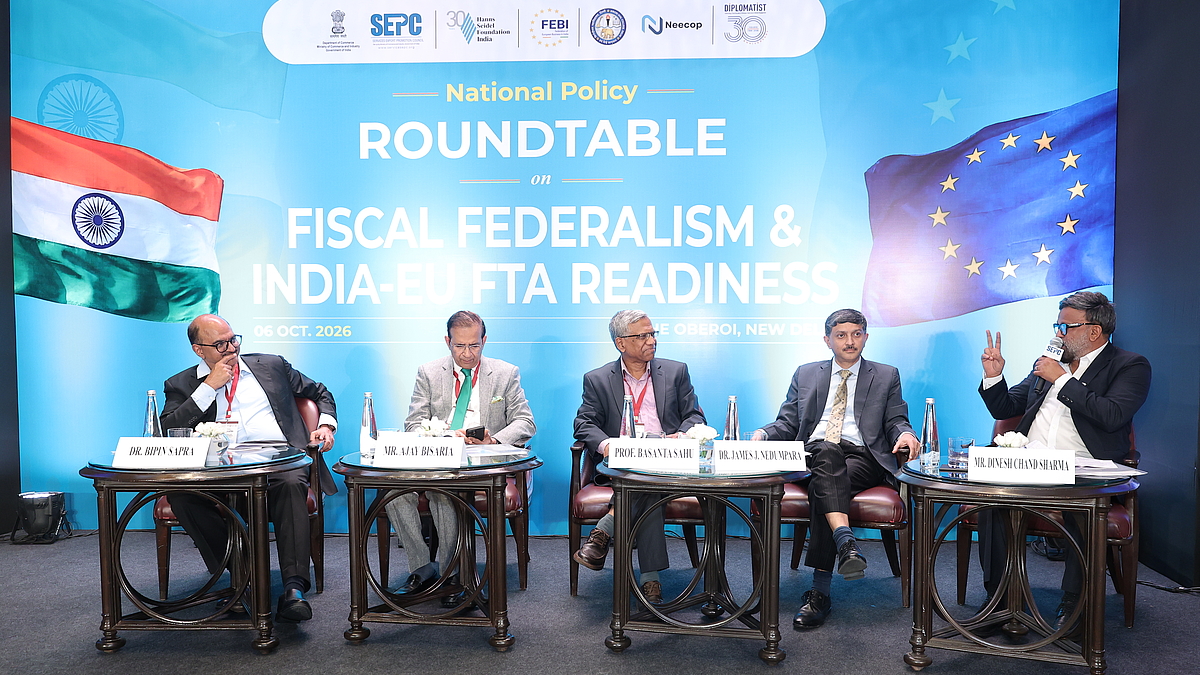
Session II: Building State Capabilities for India-EU FTA Implementation: Non-Tariff Barriers, Sustainability and Resilience
Businesses call for predictable and competitive state-level ecosystems
Session III, “From Market Access to Market Presence: What Businesses Need from States to Make the India-EU FTA Implementation Effective,” shifted the discussion towards the operational requirements of businesses.
Dr. Bidisha Bhattacharya, Associate Fellow & Head of Research, Centre for Economy and Trade, Chintan Research Foundation, provided the context-setting remarks. The industry panel brought together senior representatives of European businesses operating in India and members of the FEBI ecosystem, including Siemens Healthineers, Carlsberg, Michelin and SAP. The session was moderated by Mr. Alok Kesari, Director, Policy Advocacy & Trade Facilitation, FEBI.
The discussion highlighted that market access alone does not guarantee investment or sustained commercial presence. For European companies, decisions on where to invest and expand depend on the quality and predictability of state-level ecosystems, including power availability, land, regulatory approvals, logistics, skills and access to clean energy.
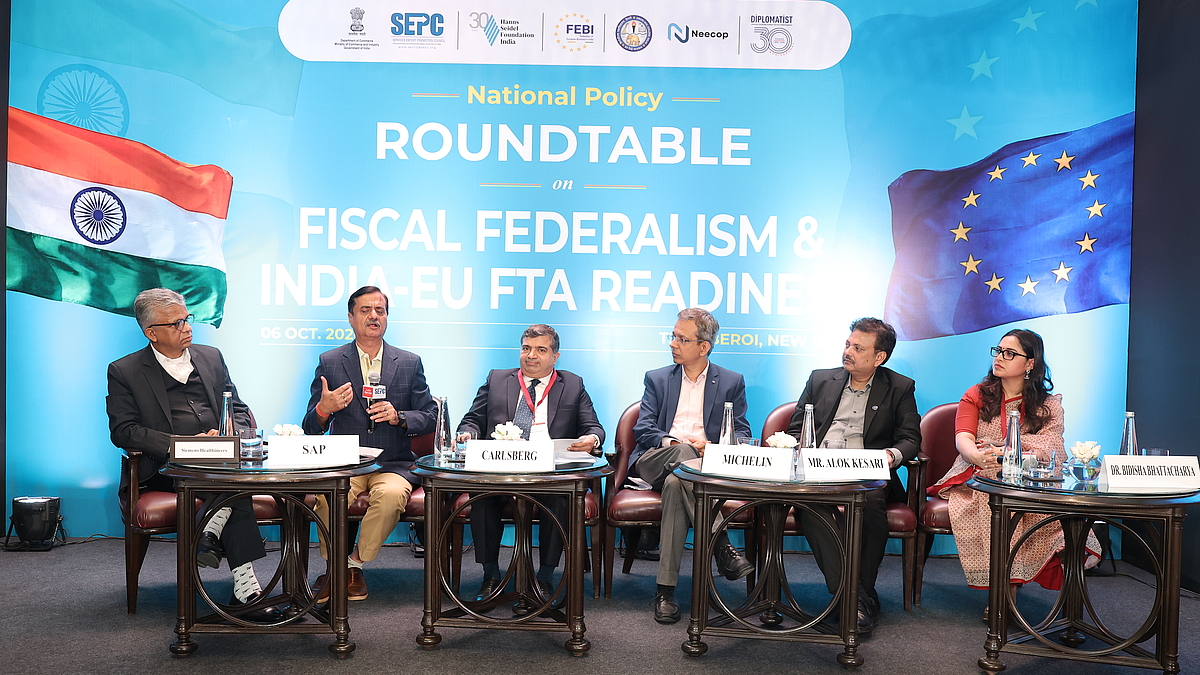
Session III: From Market Access to Market Presence: What Businesses Need from States to Make the India-EU FTA Implementation Effective
State Readiness Index to identify implementation priorities
A key outcome of the Roundtable was the emphasis on developing an EU-India FTA State Readiness Index to provide a measurable framework for assessing the preparedness of Indian states to utilise the opportunities arising from the FTA.
The discussions noted that EU-27 countries account for approximately 16.2% of India’s cumulative FDI equity inflows since April 2000, amounting to around US$128 billion. The next phase of India-EU economic engagement will therefore depend not only on how much additional investment and trade is generated, but also on which states are best positioned to attract, retain and scale that economic activity.
An illustrative assessment of an industrial state highlighted the value of a state-level readiness framework. Despite a strong fiscal position, high manufacturing productivity and progress on business reforms, access to clean power for industry emerged as a binding constraint, particularly in the context of evolving EU carbon-related requirements. The example demonstrated how a readiness index can move beyond broad rankings to identify specific policy and investment bottlenecks that states can address.
Towards state readiness for India-EU FTA opportunities
The Roundtable concluded that the success of the India-EU FTA will depend on India's ability to connect national trade policy with state-level implementation capacity. Participants called for greater Centre-State coordination, stronger institutional capabilities, improved export-oriented infrastructure, enhanced standards and certification capacity, and targeted interventions in sustainability, skills, digital infrastructure and supply-chain resilience.
The discussions also reinforced the need for evidence-based and measurable indicators of state-level FTA readiness, enabling policymakers and businesses to identify gaps, prioritise investments and track progress over time.
The Roundtable provided an important platform for bringing together Indian and European perspectives and for moving the conversation on the India-EU FTA from negotiated market access towards implementation, investment and market presence.
The central message emerging from the discussions was clear: the FTA may open the door to European markets, but India’s states will play a decisive role in determining how far businesses can walk through it.
