
Brief
Advancing a Resilient India–EU Technology Partnership Beyond Trade
Hanns Seidel Foundation India and Institute of Peace and Conflict Studies jointly organised a policy debate titled “This House Believes India–EU Tech Cooperation is Overrated” at the HSF Headquarters in Munich on 12 February 2026, under the aegis of the India-Europe Resilience Forum.
Following the discussion, we invited Dr. Nicolas Blarel, Associate Professor of International Relations at Leiden University, to share his reflections on “India–EU Technology Partnership Beyond Trade” through a brief that further examines the strategic dimensions of India–EU technological cooperation. Read the brief below.
The recent India–EU Free Trade Agreement (FTA) announced in January 2026 marks a potential strategic inflection point in a fragmented global order. However, trade liberalisation alone will not sustain a durable partnership. To build resilient and meaningful technological cooperation, India and the European Union (EU) must address structural divergences in regulatory frameworks, technological capacities, and coordination mechanisms.
This brief argues that while India–EU tech cooperation holds promise—particularly in reducing overdependence on dominant global powers—it faces significant constraints. A shift towards regulatory convergence, joint innovation ecosystems, and institutional coordination is essential to transform aspirational cooperation into a resilient strategic partnership.
The recent progress in India–EU trade negotiations marks what many observers had long considered unlikely: a meaningful step toward deeper economic engagement between two actors that are not yet major trading partners. This development could represent a broader strategic inflection point in an increasingly fragmented global order. Both India and the European Union (EU) find themselves navigating a quasi-bipolar technological landscape dominated by the United States (US) and China, while seeking to preserve their respective strategic autonomy. Yet, the durability of this emerging partnership will depend less on tariff reductions than on whether both sides can translate political intent into resilient technological cooperation.
At present, there is a risk that the India–EU relationship remains confined to trade liberalisation and market access, thereby constituting a tactical adjustment rather than a structural shift. Technology cooperation—spanning artificial intelligence, semiconductors, digital infrastructure, and green innovation—must therefore become the central pillar of this partnership. While the establishment of the Trade and Technology Council (TTC) in 2022 and subsequent initiatives signal unprecedented political will, significant structural constraints continue to limit the depth and effectiveness of collaboration. Addressing these constraints is essential if the partnership is to contribute meaningfully to supply chain resilience and reduce dependencies on external technological powers.
Bridging Regulatory and Structural Divides
A first and fundamental challenge lies in regulatory divergence. The European Union has positioned itself as a global standard-setter in digital governance, with stringent frameworks governing data protection, artificial intelligence, and digital markets. India, by contrast, has adopted a more flexible and incremental approach, seeking to balance regulatory oversight with the need to foster domestic innovation at scale. While this divergence reflects differing socio-economic contexts and policy priorities, it creates tangible obstacles for cooperation. European regulatory requirements—particularly around data protection and AI risk management—are not easily compatible with India’s evolving legal architecture. This misalignment complicates cross-border data flows, increases compliance burdens for firms, and introduces uncertainty into joint research and development efforts. For EU policymakers, the challenge is not to impose regulatory harmonisation, but to identify pathways toward interoperability that preserve core European values such as democratic constitutional standards, human dignity, and social stability as reflected in frameworks such as the EU AI Act, the Council of Europe Convention on AI, and the European Commission trustworthy AI guidelines.
Beyond regulatory issues, structural asymmetries in technological capacity between the EU and India pose a second major constraint. The EU retains significant strengths in research, innovation ecosystems, and regulatory expertise, but continues to face challenges in scaling industrial production in critical technologies. India, for its part, offers considerable advantages in terms of human capital, digital scale, and cost competitiveness, yet its technological development remains uneven. Its global reputation as an IT services hub, built on decades of success in software outsourcing, has not translated into comparable capabilities in advanced manufacturing or high-end hardware. In sectors such as semiconductors, India’s ecosystem is characterised by limited fabrication capacity, dependence on foreign design leadership, and gaps in critical inputs. India’s current comparative advantage lies primarily in labour-intensive assembly and testing—areas already dominated by established Asian players with whom the EU maintains existing partnerships.
Integrated Innovation Ecosystems
These structural realities raise important questions about the feasibility of achieving technological autonomy through India-EU cooperation given their structural dependence on US and Chinese systems. While both actors share an interest in diversifying supply chains and reducing exposure to geopolitical risks, building resilient alternatives in advanced technologies will require sustained, large-scale investment and long-term industrial coordination. The current cooperation has yet to fully leverage the potential to establish integrated innovation ecosystems or co-production frameworks. India’s limited historical participation in major EU research programmes further underscores the need for a more ambitious and structured approach to joint innovation. One possible concrete opportunity is the association of India to Horizon Europe, the EU's flagship research and innovation programme. A first round of exploratory talks was officially held in February 2026 in the context of the 16th EU-India summit, but such a discussion should be accelerated to facilitate access for Indian researchers and institutions to funded cooperation with EU partners in research and innovation (R&I).
A third challenge concerns the fragmentation of existing coordination mechanisms. The TTC provides an important bilateral platform, yet its current structure—organised into separate working groups on digital technologies, green innovation, and trade—does not adequately reflect the cross-cutting nature of technological cooperation, unlike the Initiative on Critical and Emerging Technology (iCET) framework between the US and India. Moreover, engagement remains largely state-centric, with insufficient integration of private sector actors, start-ups, and research institutions. In practice, cooperation often advances more effectively through bilateral partnerships between India and individual EU member states, such as France and Germany, reflecting specific industrial strengths and historical ties. While such arrangements are valuable, they risk undermining the coherence of a broader EU strategy if not properly aligned.
Mapping Convergence and Complementarities
Despite these challenges, the prospects for deeper India–EU technology cooperation should not be underestimated. The complementarities between both actors remain significant. The EU’s leadership in regulatory frameworks and advanced research can be effectively paired with India’s scale, talent pool, and experience in deploying its own digital public infrastructure. India’s promotion of inclusive and interoperable digital systems on the global stage also aligns, in part, with European efforts to advance democratic models of digital governance. The arrangement on Advanced Electronic Signatures and Seals signed by India and the EU in January 2026 shows a move towards further trust, cooperation, and interoperability between the EU and Indian public key infrastructure ecosystems. In an era where technological competition is increasingly intertwined with normative influence, this convergence offers an opportunity to shape global standards in a manner consistent with shared values.
To realise this potential, EU policymakers should prioritise a shift from dialogue to implementation. Regulatory engagement with India should focus on developing interoperable frameworks that allow for cooperation without requiring full alignment. This includes structured dialogues on data governance, AI standards, and digital trade, with a clear understanding of where convergence is both feasible and desirable. At the same time, the EU should support the development of joint innovation ecosystems by facilitating India’s deeper integration into European research programmes, expanding academic and professional mobility, and promoting partnerships between industry and research institutions.
A New Modus Operandi of Intensified Co-creation
In parallel, greater emphasis should be placed on industrial cooperation in critical technologies. This will require moving beyond research collaboration toward co-investment, co-development, and co-production initiatives, particularly in sectors such as semiconductors, artificial intelligence hardware, and green technologies. Strengthening supply chain resilience in these areas will necessitate not only financial commitments, but also the establishment of trusted frameworks for technology transfer that address concerns related to security and third-country interference.
Finally, institutional reform of the TTC should be considered to enhance its effectiveness. A more integrated, ecosystem-based approach—bringing together governments, industry, academia, and innovators—would better reflect the realities of technological development and accelerate the translation of political commitments into tangible outcomes. At the same time, successful bilateral initiatives between India and specific EU member states should be leveraged as building blocks for a more coherent European strategy.
Charting the Future of India–EU Cooperation
The India–EU technology partnership stands at a critical juncture. While the strategic rationale for closer cooperation is compelling, resilience will not emerge organically from the existing frameworks. It must be actively constructed through further regulatory coordination, industrial investment, and institutional innovation. For the European Union, engaging India as a genuine partner—rather than merely a market—will be essential for building a sustainable and strategically meaningful relationship. If successful, this partnership could contribute not only to greater autonomy for both actors, but also to the emergence of a more balanced and pluralistic global technology order.
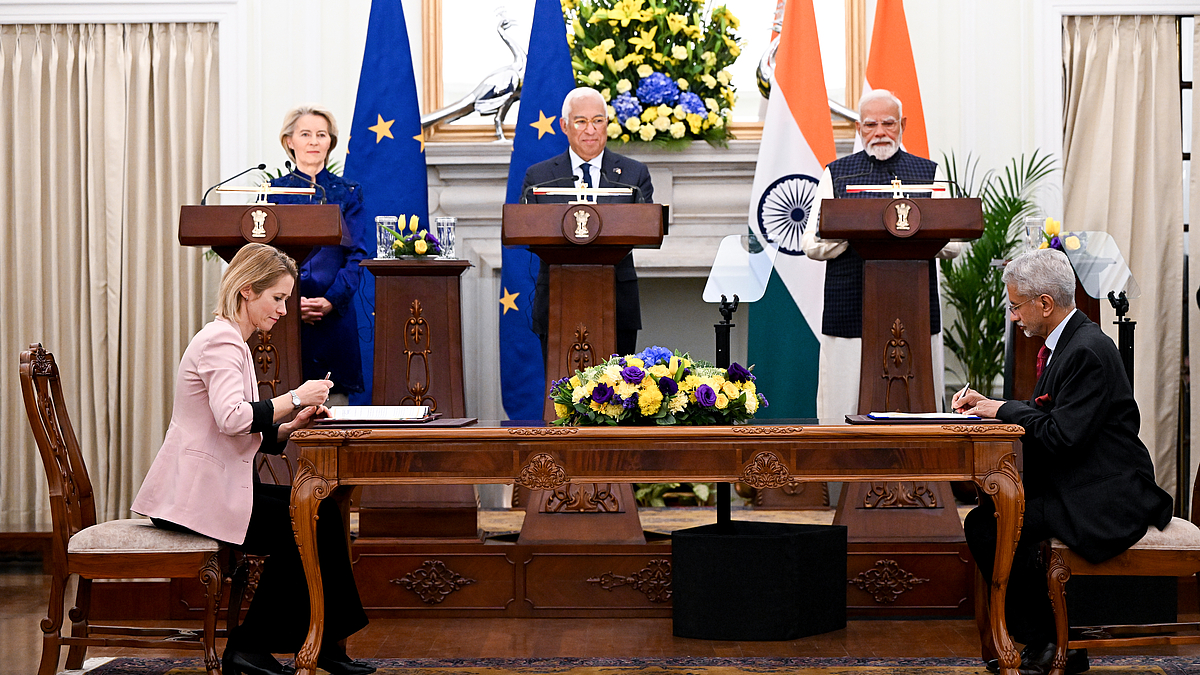
Renewal of EU-India Agreement for Scientific and Technological Cooperation until 2030 on the margins of the EU-India Summit in New Delhi. (27 January 2026) (From left to right at the bottom: Kaja Kallas, High Representative of the EU for Foreign Affairs and Security Policy, and Dr. Subrahmanyam Jaishankar, External Affairs Minister of India. From left to right at the top: Ursula von der Leyen, President of the European Commission, António Costa, President of the European Council, and Narendra Modi, Prime Minister of India.) | Image credit: European Union
Disclaimer: The views expressed above are those of the author and do not necessarily reflect the views of Hanns Seidel Foundation.